Flight to Egypt to Sadat
An understanding of God’s promise to the offspring of Hagar and her seed, and the prayers for the Arab people, led slowly but directly to Hannah’s visit in June 1980 to President Sadat (and separately with Mrs. Sadat at one of her offices) in Egypt as well as her hour-long visit with the terminally ill former Shah of Iran, to whom she presented a Bible in the Persian language, received with tears.
How can I capture in a few words and paragraphs the agony and ecstasy of 1980? On January 1, 1980, a missionary friend wrote me from Spain, “Isaiah 26:3 just came to my mind for you.” Later that week a missionary elder statesman wrote me the same verse, as did the widow of a missionary martyr: “Thou wilt keep him in perfect peace whose mind is stayed on thee; because he trusteth in thee.” Isaiah 26:3
Flight to Egypt to Sadat
How can I capture in a few words and paragraphs the agony and ecstasy of 1980? On January 1, 1980, a missionary friend wrote me from Spain, “Isaiah 26:3 just came to my mind for you? Later that week a missionary elder statesman wrote me the same verse, as did the widow of a missionary martyr: “Thou wilt keep him in perfect peace whose mind is stayed on thee; because he trusteth in thee.”
I had a back operation on April 10 at the very hour I was to have met President Sadat of Egypt in Washington. When I told my Iranian-born surgeon my dilemma, he said, “Don’t worry! We’ll get you back on your feet so that you can go to Egypt to see President Sadat.” Who would have known that these were prophetic words? Just seven weeks later I was in his office and in the office of my Cairo-born internist, getting their full approval for a trip to Cairo. That confirmed the assurance we had received at our Tuesday night meeting that I had attended with extreme pain. The Lord’s word was definite: the waters of impossibility, like the Jordan River between the Israelites and the promised land, would recede, as we stepped in by faith.
May 30 at 9:00 p.m. found me stepping into the waters by faith, with Amy and Andrew, as we boarded TWA Flight #840 for Rome. We spent three days there and visited the church where I had preached on my return from Bethlehem in 1952, after working with orphans for a time, in the Holy Land. Then, on June 3, on to Cairo! We had no sooner landed than the loudspeaker announced, “Mrs. Lowe, Mr. Burrows, Miss Reysen: someone’s here to meet you.” This was a surprise to us, but there at the foot of the stairs was “our man” in Cairo: ESSAM Youssef, the most helpful, cordial, on-top-of-every-detail Moslem you can imagine. After an effusive Egyptian welcome, he informed us that the President’s limousines would be coming to the hotel the next morning to take us to a noon meeting with Mr. Sadat at Ismailia on the Suez Canal. He then sat us in the press room of the Cairo Airport, awash with visitors in turbans and white robes from all over the Middle East, while he handled all the formalities. Soon we were in the spacious lobby of the brand-new Heliopolis Sheraton Hotel, filled with tropical plants and free-flying birds.
Harald Bredesen, a friend of thirty years who can best be described as an Ambassador-at-large for the Gospel, had developed a relationship with President Sadat. He had arrived in Cairo a few days earlier and he met us at the hotel. We marveled how my concern for another world-renowned figure, borne in prayer for nearly two years was finding fulfillment. For a long time the doors had seemed tightly shut but, suddenly, they were open.
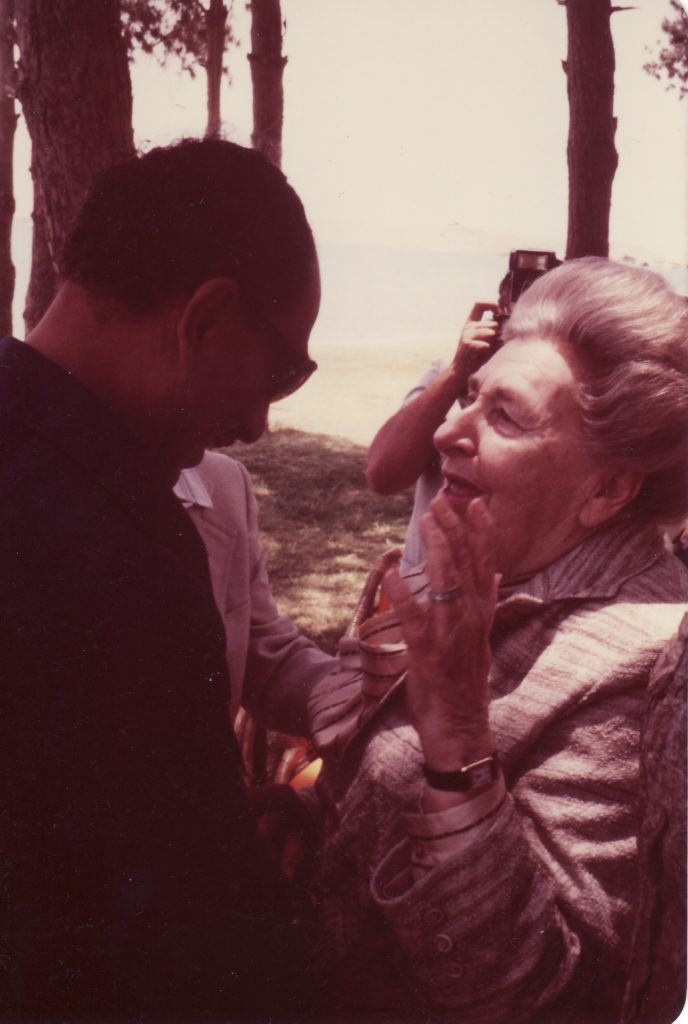
Early Wednesday, June 4, three presidential limousines took our party two hours through the Egyptian Desert, seeing nothing but sand and an occasional military encampment of tents in the wind. As we neared Ismailia some vegetation appeared, but the President’s compound was emerald green on the banks of the azure blue Suez Canal. Escorted to a windswept grove right at the edge of the canal (as beautiful as the desert was bleak), we were treated to a warm Egyptian welcome by President Anwar el-Sadat, as flashbulbs popped and TV cameras whirred. The picture above was published on page one of October magazine, the Egyptian equivalent of Life.
“When you feel good about ten times a day,” Harald enthusiastically introduced me to the President, “it is because Hannah Lowe is praying for you.” Soon our party was alone with President Sadat for 45 minutes, talking about the relationship between the Christians (predominantly Coptic Orthodox) and Moslems, and also the position of Egypt in a volatile Middle East. Harald then called on me to pray. First I asked Andrew to open the Bible to Isaiah, chapter 19, where he read, “In that day shall there be an altar to the Lord in the midst of Egypt… And the Lord shall be known to Egypt and the Egyptians shall know the Lord in that day… Blessed by Egypt my people.” We then stood in a circle, with our arms clasped around one another. The Lord strengthened me to pray at some length: for President Sadat, his family, his country and the plan of God. “That prayer will do me much good!” Mr. Sadat beamed. He inscribed his autobiography, In Search of Identity, to me. And before we left, he kissed me goodbye.
Before leaving New York, when I had told my Egyptian-born internist of my trip, he strongly urged me to try to see Mrs. Sadat. I mentioned my hope to the President and he resounded, “You shall see her!” I did, but how I did is a story in itself.
The night after we had seen President Sadat, Harald became critically ill with acute dehydration. A member of the People’s Assembly, having heard of our meeting with President Sadat, called the next morning to say that they had to see Harald that day. I cautioned Harald that his health was at stake, but my actions apparently outweighed my words. “Yes,” he said, “I’m going to do just what you did: get out of a hospital bed to come all the way over here to Egypt.” Harald went and spent hours with the members of a special Assembly committee. He met Egypt’s youngest judge, now an Assembly member, NASHAT Kamel Barsoum. Nashat invited Harald and us to come to his home in Giza for dinner on Saturday. I do not know how I was able to walk up the three stories to his apartment, but it was worth it because Nashat received the Lord Jesus Christ as his personal Savior that night. His mother was very happy. We presented him the New International Version of the Bible.
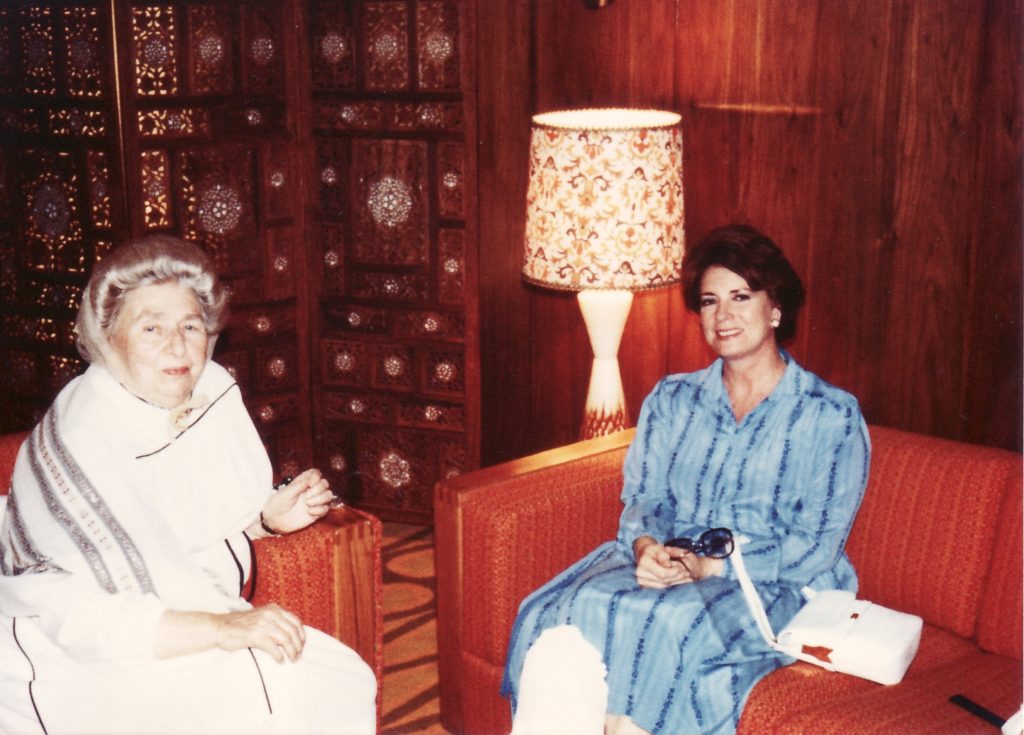
Nashat became a firm friend and he went to great lengths to make the arrangements for us to meet Mrs. Sadat. The day before we were to leave Cairo, we had a blessed hour with Mrs. Jihan Sadat in her office at her rehabilitation center for the disabled. She was fascinated by the pictures of my work with the Arab orphans in Bethlehem and my picture with King Hussein. Best of all, she was glad that I asked to pray with her. So there, as I sat just two feet from the President’s gracious wife, I thanked the Lord for bringing us over the seas to meet the lovely Egyptians, but even more for the gulf our Savior bridged—the sin that separated us from God.
Were I to end here with our 12-hour trip home on June 15, I would slight the welcome we received from Egyptians of all stations. They know how to make you feel at home! We could sense the hunger they have for the truth, after long, dry centuries. We had come to know our man in Cairo, ESSAM, by a sovereign connection Harald had made with a man in Omaha, Nebraska. Essam did everything that could be done to assure that all went smoothly, finding us whatever we needed and arranging for many things that seemed impossible. Counting it a privilege, he was up at four in the morning of our last day to take Andrew and our bags to the plane and then come back for Amy and me so that I could have the most rest possible. In all my long years, I can only say that I have never met anyone whose thoughtfulness was more practical, instant and effective.
We prayed for his spiritual awakening. One day Andrew found his way to the grave of Oswald Chambers, author of My Utmost for His Highest, in the British Cemetery in Old Cairo. That evening, grateful for the opportunity that he had had, Andrew was telling Essam about it, as we had something to eat. He told of the simple inscription on the tombstone: “A believer in Jesus Christ.” Essam’s response was marked. He was affected. We have prayed for him ever since. Just last week we spoke to a man who had recently returned from Cairo. “Good news!” he said, “Essam has been born again. He accepted Jesus Christ as his Savior.” He also told us of a church in Cairo with a sincere, godly pastor, where the Holy Spirit is moving. He put Essam in touch with that pastor. And who was it that had put him in touch with the church? None other than our friend Nashat, who is doing very well.
All the hotel employees were hospitable; many had a deep hunger for God and for His word. One afternoon, a hotel maid and a houseboy came to Andrew’s door, a bit nervous and said, haltingly, “Please…Holy…Bib-ble.” Andrew rejoiced to give them each a copy of the Arabic New Testament. Soon others knocked at the door with the same request and thus many Arabic New Testaments found their way into the eager Egyptian hands of Esmat, Roshoi, Hanig, Said, Rashod, Sayed, Ikbal, Shafika and Hassam.
We had not gone to sightsee, but one morning Andrew had an hour free between buses and went into the Egyptian Museum that houses the incredible treasures of King Tut and the remains of thousands of years of history. It all adds up to a fascination with death in a futile attempt to insure immortality. As he was about to leave, one of the soldiers on guard beckoned him to a side room to show him a baby mummy and a mummified goat. In return, the soldier asked for a gift, in very broken English. Andrew gave him a copy of the “Life of Christ” in Arabic. The news traveled fast. In the ten minutes it took Andrew to walk out of the museum to catch a bus, no less than eight soldiers came up to him quietly asking for the same thing, receiving gladly the word of God’s unspeakable gift.
Of all those we met at the hotel, two stand out from the rest for their responsiveness to the word of God. Garbed in traditional Egyptian dress (worn by few these days) was the hotel doorman, OSSAM Reda Fayz. He was friendly and more than that, he always wanted to talk about the Lord Jesus. He seemed to understand much of what it is all about. When he learned we were leaving, he said that he would be at the airport. We told him that it was kind of him, but not necessary. Well, there he was at five in the morning with gifts for each of us. He gave us as cordial a sendoff as the welcome that we had received in Egypt.
The maid for my room was a young woman of special quality, IGLAL Shafiz Aziz, who had studied to be a secretary, but had not been able to find secretarial work. One day we found a vase of fresh gladiolas in my room – you have to see how arid Egypt is to appreciate how special flowers there are – with the note, “To my love, My mother Hannah. I hope you’ll be better. Iglal.” She and her family wanted us to come to their home for dinner, but my pain was so bad that I could not go. She was moved by my suffering. Soon after returning, I received my first letter from Egypt:
Dear Mother Hannah, Cairo 16-6-1980
I wish you will receive my letter and your health very well and no more pain.
I have prayed for God to safe you and to keep you well for your trip back home. Today, Monday, my Chief gave me the envelope you have left addressed to me with your lovely two pictures and included was the gift. I am very glad to have your photo with me – that means that you will be always in front of my eyes and at any time. Wishing that the laugh that I have seen is back to your face. I never forget you and I am sorry for the short time you have stayed with us. I wish you to try again to visit us shortly, and wishing to hear from you good news.
My father, mother and brother were anxious to see you during your stay, but their were unlucky and they extend their wishes to all of your family. May Lord bless you and keep you well to continue serving his name to the whole world. I am sure he will save you and keep you in good health.
Wish to hear from my kind mother good news. Until then heart regards to you & your children which I am one of them. With heart love, your daughter, Iglal.
She wrote me again in July, just as delightfully, and then last month I received this:
My dear Mother, Mrs. Hannah Lowe,
I always think of the short and nice time you stayed with us here in Cairo.
I and my family always mention your name in our prayer for God to keep you in very good health as to resume and continue serving the name of the Lord so many years and in the whole world. Your daughter for ever, Iglal.
For me, she is one of the treasures of Egypt.
Perhaps the most spiritual reaction to our trip came from a dear friend I made in England 30 years ago on my way home from Jordan. I imparted to her then my vision for the Jews and she has been an ardent and informed supporter of Israel ever since.
My beloved Hannah, 25-6-80
I was so impressed with my readings yesterday – as you so came into the picture. First reading: Proverbs 24:17-18, re: rejoicing not when one’s enemy stumbleth. After that, my other reading came to Isaiah 19 – the burden of Egypt and the punishments – which up till recently I should have been very glad about, being such enemies of my beloved seed of Jacob. In the past I have disapproved of the marvellous turn about!! – closed my eyes to it, but yesterday, the whole thing came together – & you jumped into it – I saw this great conversion of Egypt is going to be manifest. Surely you have been God’s appointed servant to set to turn the tide going. I am sure none of us can know the mighty work that has been accomplished through you, & the miraculous way at your age & your state of body it has been chosen by God to be done, until we are in Heaven. How marvellous are His ways of establishing mercy to the most unlikely creatures – & not a single punishment falls from Him on anybody that is not motivated by Mercy unbounded to be revealed at the one right time. So my heart has turned right round to Egypt, & I worship God for the glory of His unfoldings revealing His Whole Name.
Will have to close here – God bless & strengthen you for the end time purposes He is working thro’ you & your beloved children. With all my love & honour to you
Our visit with President Sadat in a windy grove on the Suez, as important as it was, was not the reason for our going to Egypt. In these few lines, I have told but a part of half of the story. The other half, and the leader for whom the Lord had so deeply burdened me, I trust to tell you of very soon.
How I wish I could end this with the news that my health had fully improved! But since returning I have been in the hospital three times (in July, for tests; in August, for two operations, one on my foot and again on my spinal column; and recently, for six weeks, including two weeks in intensive care). All here are standing steady, believing for me. I am getting stronger, though the pain is still intense in my right leg and foot. I hope soon to return to Colombia, as well as to get back to Egypt. I cannot say that I understand it all, though I do know that I can understand those who suffer better than I did before. And I believe, as Job did, that “He knows the way that I take; when He has tested me, I will come forth as gold.”
Thomas and Hannah Lowe
There was no modern Israel when Hannah Lowe and her husband, Thomas Ernest Lowe, received the call of the Lord to the Jews—and, as they believed, to Palestine, in the early 1930’s. In 1934, they very nearly went out to that disputed territory, but the way did not open then.
Mr. Lowe turned instead to Colombia, South America, where he served with Hannah until his death in 1941, and where Hannah continued to work for over 40 years. But where the feet were not able to go, the heart could and did, bearing a never-diminished burden for the Jews and for Israel.
In 1952, Hannah at last had a full opening to go to the holy land for many months. It perplexed her initially when she found that she was among Arabs and Orthodox Christians, instead of with Jews. When she lifted this to the Lord, He showed her Genesis 21:12-21, regarding His preservation of the offspring of Hagar and His promise to the cast-out woman and her seed: so the Arabs and the Muslims are Gentiles, too, needing the salvation of Jesus Christ.
That understanding, and the prayers for the Arab people, led slowly but directly to Hannah’s visit in June 1980 to President Sadat (and separately with Mrs. Sadat at one of her offices) in Egypt as well as her hour-long visit with the terminally ill former Shah of Iran, to whom she presented a Bible in the Persian language, received with tears.