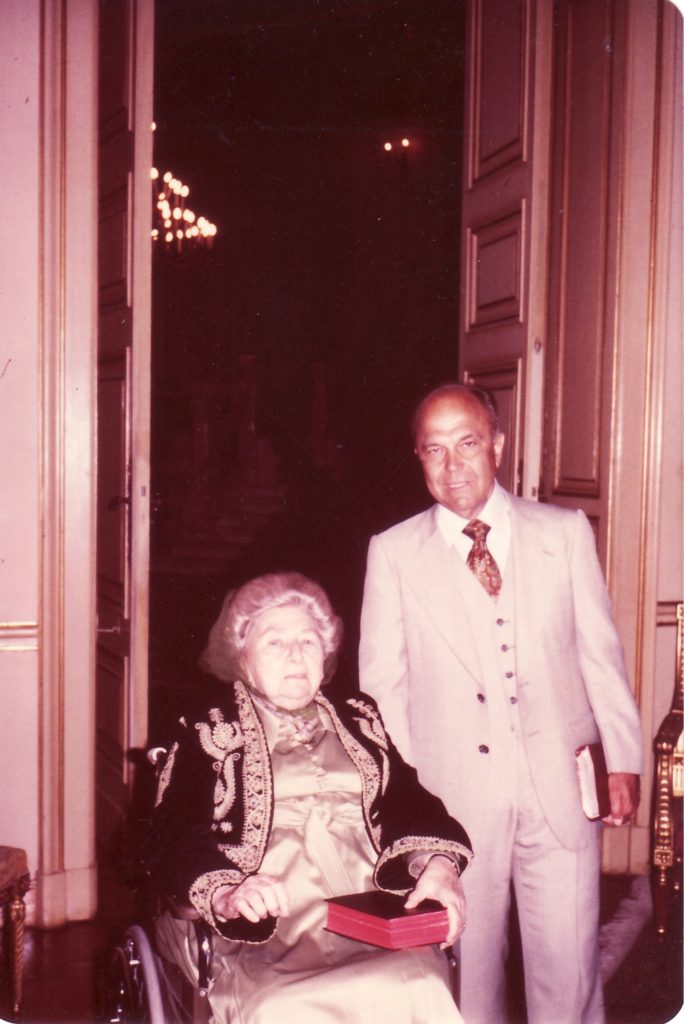
Iran: Meeting with the Shah
An understanding of God’s promise to the offspring of Hagar and her seed, and the prayers for the Arab people, led slowly but directly to Hannah’s visit in June 1980 to President Sadat (and separately with Mrs. Sadat at one of her offices) in Egypt as well as her hour-long visit with the terminally ill former Shah of Iran, to whom she presented a Bible in the Persian language, received with tears.
Iran: Meeting with the Shah
“Thou Shalt Stand Before Kings”
I promised that I would tell you of the other half of the trip to Egypt. (Read here about Hannah’s visit with President Anwar Sadat.)
A burden is not something one takes upon oneself; it is given of the Lord and is borne as a consequence of His action in imparting it. If it is borne faithfully, it will ultimately and surely bear fruit. Yet the way to that result may be impeded and very difficult.
So let me go back a while. A friend of mine, a man of prominent social standing, had attended the celebration in Iran of the 2,500th anniversary of the founding of the Persian empire (by Cyrus the Great). He told me of it and showed me a picture of himself with the Shah of Iran, Reza Pahlavi. That was in 1971.
Late in 1978, while I was working in Bogotá, stories began filtering through of rising troubles for the Shah. The Lord moved me then to pray for him, and I continued to do so through the crisis, the deposing of the Shah, and the taking of power by the Ayatollah Khomeini. The Shah, as you know, took his flight first to Egypt, then to Morocco and Bermuda, and Mexico, then to New York, to Texas, to Panama – and later again to Cairo. The burden did not subside, but remained. I believed that I was to meet the Shah and to minister to him and his family, but, oh, how remote and distant that possibility seemed to become.
When the Shah was in New York, a matter of a few miles away from here, there seemed to be some slight prospect of seeing him, but then he had to leave (for Texas) and got farther (in Panama) and farther (in Egypt) away.
Several times I had told Harald Bredesen of my continuing burden. We talked at length on one occasion at the New York airport, when Harald was departing for Egypt, summoned by the Shah’s close friend, President Sadat. But it took some very particular actions by the Lord to make the way.
Last April 10th, Harald was to meet with President Sadat at Blair House in Washington, D.C. Very early that morning, Harald received a phone call from a friend who told him that God wanted him to see the Shah of Iran. Still before dawn a second call came, this one from a minister friend who told Harald that the Lord had shown him that Harald was to see the Shah and that President Sadat was the key.
So, at Blair House that day, Harald’s friendship with President Sadat was renewed and he spoke to the President of the Shah. He and Mrs. Sadat were eager for Harald to return to Cairo to visit the Shah and his wife. “They feel so abandoned,” Mrs. Sadat urged, “Come quickly!”
Well, if “quickly” had meant any sooner than the end of May (after my April spinal operation), I don’t think that I could have made it, but, as you know there we were in Cairo, Egypt, on June 3rd, rejoicing with Harald that my prayer burden was finding fulfillment: we were to see the Shah at the magnificent Kubbeh Palace the very next evening.
But first we were to meet with President Sadat in the morning on the banks of the Suez Canal. When we told him that we were going to see the Shah that evening, he rejoiced, “I’m glad that you’re going to see the Shah. This is just what he needs. I’m sure it will do him much good.” Alone of the leaders of the world, Sadat had offered the exiled Shah a place of welcome, taking a clear stand from the beginning and never wavering in his readiness to put it into effect. When all other doors shut in his face, and Panama seemed ready to accede to Iran’s demand for extradition, it was to Egypt that the ailing Shah had made his way to a warm welcome by President Sadat and the Egyptian people. They placed the large palace that King Farouk once called home at his entire disposal. It was clear that President Sadat’s concern was not political, but personal.
So it was with President Sadat’s blessing, and in the limousines that he provided, that we rode through the busy streets of Cairo at 6:00 p.m. to a set of imposing, closed gates. Stopped at the gates, we were granted entrance and drove through acres of flowering grounds to a second set of gates and then to the 200-room marble palace. Off to the left, a child played on a bicycle. Up the wide steps, past the gilt tables and ornate vases of brilliant fresh flowers, past tapestries, Oriental carpets and parquet floors, up the green-carpeted stairway (to my relief, they had an elevator to the second floor, as I was in a wheelchair), we were ushered into a huge bedroom with a canopy bed. In it was a frail, sharp-featured man, with a fever, and at his bedside, gracious beyond description, his lovely wife, Empress Farah.
My wheelchair put me at eye level as I was introduced to the Shah of Iran. He was solicitous to know how my operation had turned out. The introductions went quickly; there wasn’t an awkward moment. Harald began telling the story of Joseph, in detail. That found warm response. The story is famous in Iran, the Empress told us. For me, it was even more striking because, unknown to Harald, I had used the same story in a letter to the Shah on November 29, 1979, when he was in New York Hospital. When Harald finished, Andrew read a copy of my letter:
His Excellency, Shah Mohammed Reza Pahlavi:
I am sure you know the story of the patriarch Joseph, how his brothers sold him into slavery and how, later, when they asked his forgiveness, in Egypt, he said, “You meant it to me for evil, but God meant it to me for good.”
I am an American and have been a missionary overseas for a long time. For more than a year, I have prayed for you and I have asked others to do so.
Some years ago, God enabled me to meet with and stand with a group of statesmen, exiled from their homeland…. I encouraged them to pray and to ask God for definite help.
I worked for a year in Bethlehem, where I came to know King Hussein. The God Who cares for the Middle East is a God of mercy and love, not of cruelty and hate. I believe there is a future for the people of Iran. As dark as things seem now, God knows and cares and loves Iran even more than we do.
As Andrew read, the strong awareness came upon all present that the Lord was doing something very special. Harald told of my work with Colombia’s exiled leaders. We were to have stayed only 20 minutes, but after an hour the Empress did not want us to go. We prayed with the Shah and I presented him the Bible in his own Persian language. Momentarily overwhelmed, as one receiving the most valuable of gifts, he collected himself and thanked me graciously. The deep hollows under his eyes filled with tears. I could have cried myself, for joy and sorrow.
But still I had not met the Shah’s children. One evening in our hotel lobby ladies room, Amy and I started talking with these girls. Amy asked them, “How do you say, ‘Pardon me,’ in Arabic?” The tallest answered, “We don’t speak Arabic.” When I learned that their native language was Persian, I asked, “Did you know the Shah?” They said yes. And then I asked, “Do you love the Shah?” “Yes.” “But do you love him with all your heart?” “Yes, we do.” They laughed. “So do I!” I told them (their brother had joined us in the lobby) “I came all the way here after an operation to see him, but I am so sad that I have not met his children. I love them very much.” They looked at one another and finally their companion, Morad, said, “You are speaking with them now.” I could hardly believe my ears. The Crown Prince was in the States, but there in my hotel were Princess Parahnaz (17), Prince Ali (14) and Princess Leila (10). “I saw you when you came to the palace the other night,” said darling Leila, “going up the marble steps.” “I saw you too,” I replied, “on your bicycle.” I don’t know who was happier, they or I, but we were all so glad, including Leila’s nurse, Gogol. They all kissed me goodbye.
After we returned to the States, on my birthday in July Harald called me from California with the news that Empress Farah had just called him from Cairo. She and the Shah were deeply grateful for our visit. She told Harald the story of the children meeting me at the hotel. She said that the children had returned to the palace that day ecstatic and could not get over how much love I had expressed for them, not knowing with whom I was talking. Then I spoke to Empress Farah in August to console her after the death of her husband. As a widow, I can understand the sorrow she bears. And just last month the Empress and I spoke again by phone. She told me that the children are doing well and that there is great responsibility on her 20-year-old son, Reza, as the declared new Shah. Reza had to make that declaration, under long-standing Persian law, on his recent birthday, or else forfeit the position forever. Pray for him. The Empress said that the grace of God was sustaining them, asked for our prayers and described the people in Iran as suffering intensely, waiting for “some miracle to happen to save them.
Just before Christmas, I received a gracious gift from the Empress – a magnificent book entitled Iran: Elements of Destiny. It is an exquisite panorama of Iran (Persia) and its history, with hundreds of color photographs of recent decades and especially of the late Shah and his family.
So it was that a burden given was brought to wholly satisfying initial fulfillment. The Shah was seen. He was told of the love of God and given the Scriptures in his own tongue, short weeks before his death. Personal friendship was established with nearly every member of that lonely, hunted, despised family. I believe that God has purposes for them.
Most of you know that my first call was to the Jews, and that has never changed. Many years ago the Lord gave me a vision. I saw a vast desert and a man in a turban, very worn and reduced to crawling. He was trying to reach a very narrow stream of water. When he reached it, he drank. I knew this spoke of the Arabs. The stream was the water of life. Later, in the early 1950s, I was led to the Middle East and, to my surprise, specifically to Arabs in Jordan. When I asked the Lord concerning this, He said, “What are you?” I said, “I am a Gentile.” And He said, “So are the Arabs.” He told me that they deserve the same opportunity to hear the Gospel that I had had, and that this will be true “until the fulness of the Gentiles be come in” (Romans 11:25).
Finally, I need your prayers in the year ahead. Fulfilling the ministry to which God has called me in Colombia, in the United States and in the Middle East is, not only at this age, but at this stage of physical affliction, important, yet doubly difficult. It is His grace alone that has upheld me through the three operations and major hospitalizations of 1980, and my heart’s desire is to serve Him until I complete the race that He has set before me.
Thomas and Hannah Lowe
There was no modern Israel when Hannah Lowe and her husband, Thomas Ernest Lowe, received the call of the Lord to the Jews—and, as they believed, to Palestine, in the early 1930’s. In 1934, they very nearly went out to that disputed territory, but the way did not open then.
Mr. Lowe turned instead to Colombia, South America, where he served with Hannah until his death in 1941, and where Hannah continued to work for over 40 years. But where the feet were not able to go, the heart could and did, bearing a never-diminished burden for the Jews and for Israel.
In 1952, Hannah at last had a full opening to go to the holy land for many months. It perplexed her initially when she found that she was among Arabs and Orthodox Christians, instead of with Jews. When she lifted this to the Lord, He showed her Genesis 21:12-21, regarding His preservation of the offspring of Hagar and His promise to the cast-out woman and her seed: so the Arabs and the Muslims are Gentiles, too, needing the salvation of Jesus Christ.
That understanding, and the prayers for the Arab people, led slowly but directly to Hannah’s visit in June 1980 to President Sadat (and separately with Mrs. Sadat at one of her offices) in Egypt as well as her hour-long visit with the terminally ill former Shah of Iran, to whom she presented a Bible in the Persian language, received with tears.